
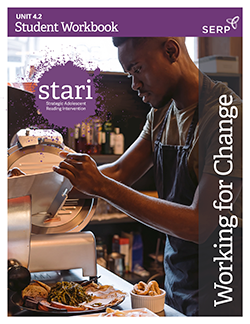
Unit 4.2 Working for Change
Working for Change focuses on the challenges and resilience of working people. The unit focuses on children and young people who work, from the labor movement of the early 20th century up to the recent fight for a $15 per hour minimum wage.
UNIT TEXTS
- Fifteen and Change by Max Howard
- Kids on Strike by Susan Campbell Bartoletti
- “A Boy’s Duty” by Sharon G. Flake in Fresh Ink by Lamar Giles
Students begin this unit by reading the short story “A Boy’s Duty” by Sharon Flake, published in the collection Fresh Ink. The short story takes place during WWII. The main character is a 16-year-old young man who has run away from home, and is living on the streets of New York City. He aspires to be an artist, but is also considering lying about his age to enlist in the military. His father says he should come home, because his duty is to his family and their farm. The story raises questions about the concept of duty. Students will discuss to whom and to what we have a duty. Next, students read several chapters from the nonfiction book Kids on Strike, by Susan Campbell Bartoletti. This book describes the labor movement of the late 1800s and early 1900s, with a focus on child labor. In this text, students are introduced to content about unions and strikes. Finally, the unit’s core novel is Fifteen and Change by Max Howard. This novel is written in verse and tells the story of a 15-year-old who starts working at a pizza place, hoping to provide financial help for his mother. A coworker tries to recruit him to join the fight for a $15 per hour minimum wage. The novel touches on working conditions for low-wage workers, and raises questions about duty to family and friends.
FLUENCY TOPICS
WWII, Langston Hughes, Emily Dickinson, well-known strikes, child labor, workplace harassment, health insurance, payday lending, homelessness, domestic violence, pizza making, Wisconsin

FOCUS
Literary analysis
- Analyzing how complex characters develop, advance the plot, and interact with other characters
- Features of poetry including line breaks, rhyme scheme, word choice (e.g., figurative language), and theme
Reading comprehension
- Predicting and confirming/disconfirming predictions as a component of Reciprocal Teaching
- Previewing nonfiction using the table of contents, index, and illustrations
- Skimming and scanning as nonfiction reading strategies
Decoding
- Pronouncing vowel teams
- Identifying syllables as units within words
- VC|CV syllable division rule
Debate
- To strike or not to strike?
- Was Zeke successful in bringing about change?
English language development
- Offering alternatives to extend or deepen awareness of factors that contribute to particular outcomes
- Interpreting figurative language and connotations of words and phrases